
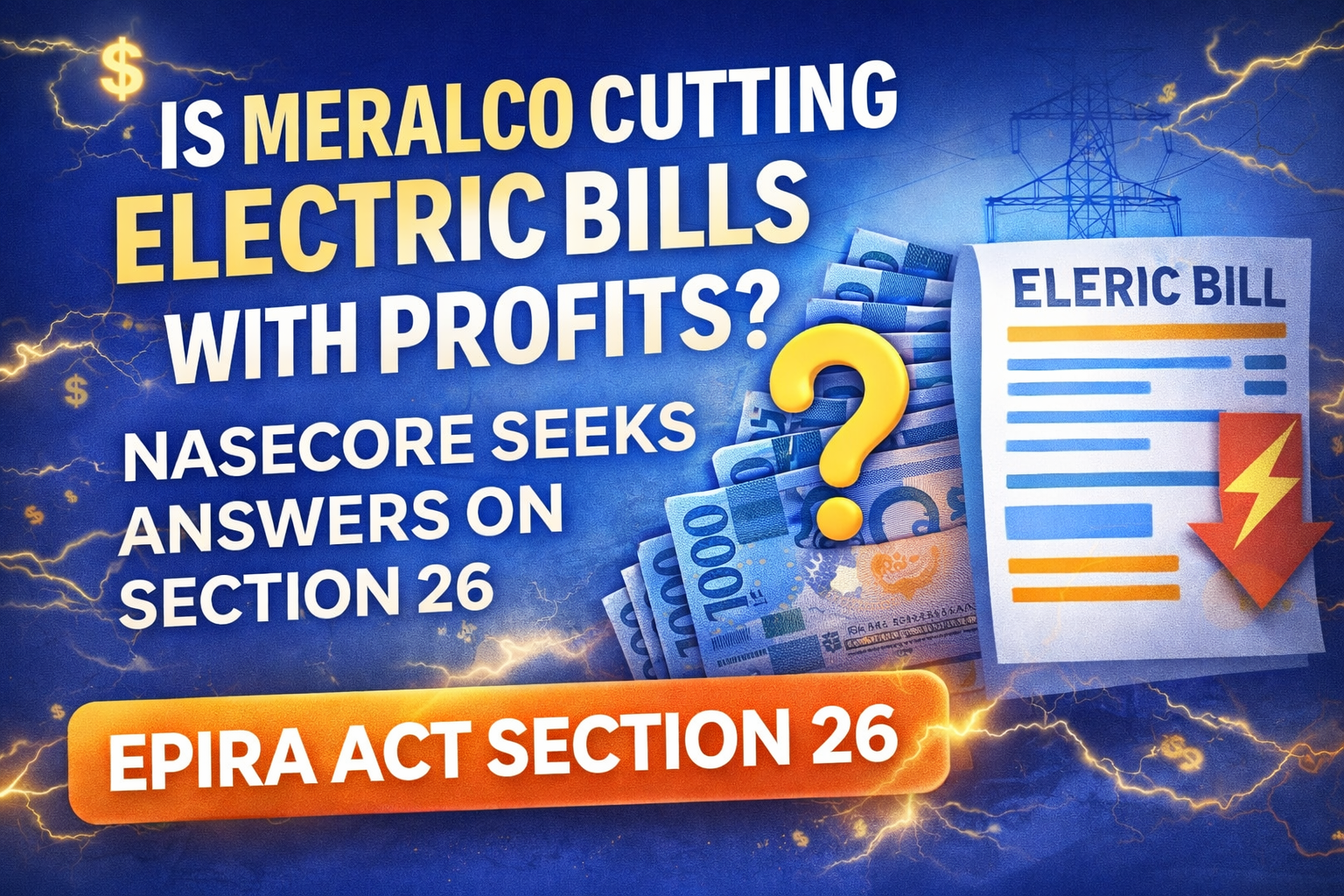
On 22 January 2026, the National Association of Electricity Consumers for Reforms, Inc. (NASECORE) formally wrote the Energy Regulatory Commission (ERC) to seek clarification on the implementation of Section 26 of the Electric Power Industry Reform Act (EPIRA)—a provision intended to ensure that electricity consumers benefit when distribution utilities earn income from related businesses.
This communication is not a complaint and not an accusation. It is a formal inquiry anchored on transparency, faithful implementation of the law, and the protection of captive electricity consumers.
What Section 26 of EPIRA Requires
Section 26 allows distribution utilities, such as Manila Electric Company (MERALCO), to engage in distribution-related or asset-maximizing businesses only if strict conditions are met. Most important among these is the requirement that a portion of the net income derived from such undertakings must be used to reduce distribution wheeling charges, subject to ERC determination and safeguards against cross-subsidy.
Compliance with Section 26 is not optional. It is conditional and cumulative, requiring satisfaction of all four statutory conditions, including:
- confirmation that the business maximizes distribution assets;
- verification that net income is actually applied to reduce wheeling charges;
- observance of the 50% income limitation; and
- maintenance of separate accounts with no cross-subsidy or encumbrance of regulated assets.
Why NASECORE Raised the Inquiry
Based on MERALCO’s 2022–2024 Annual and Integrated Reports and Audited Financial Statements, the utility has disclosed significant and growing investments in subsidiaries, associates, and joint ventures—covering power generation, retail electricity supply, engineering, ICT, financial services, real estate, insurance payments, and other non-core or “beyond-energy” activities.
Given this expansion, NASECORE asked a simple but crucial consumer question:
Have these investments resulted in actual reductions in distribution charges, as Section 26 of EPIRA requires?
What NASECORE Asked the ERC to Clarify
In its letter, NASECORE respectfully requested the ERC to identify and confirm, for each relevant subsidiary, associate, or joint venture:
- whether it has been determined to fall under Section 26;
- whether income from such entities has been applied to reduce MERALCO’s distribution wheeling charges;
- whether ERC approvals or determinations support such treatment; and
- whether proper accounting separation and anti-cross-subsidy safeguards are in place.
NASECORE also sought transparency on investment growth from 2017 to 2024, including whether increased investments involved regulated assets or consumer-funded revenues, and how any resulting income was treated for rate-setting purposes.
Why This Matters to Consumers
Section 26 exists to ensure that when a utility earns from businesses that rely on distribution assets paid for by consumers, consumers share in the benefit—through lower charges. Without clear disclosure, verification, and regulatory determination, this statutory protection risks being reduced to a formality rather than a real safeguard.
This inquiry is part of NASECORE’s continuing effort to promote:
- transparency in rate-setting,
- clear segregation of regulated and non-regulated activities, and
- faithful enforcement of EPIRA in the interest of millions of electricity consumers.
NASECORE respectfully requested a written response from the ERC to place these matters on record and help clarify how Section 26 is being implemented in practice.