

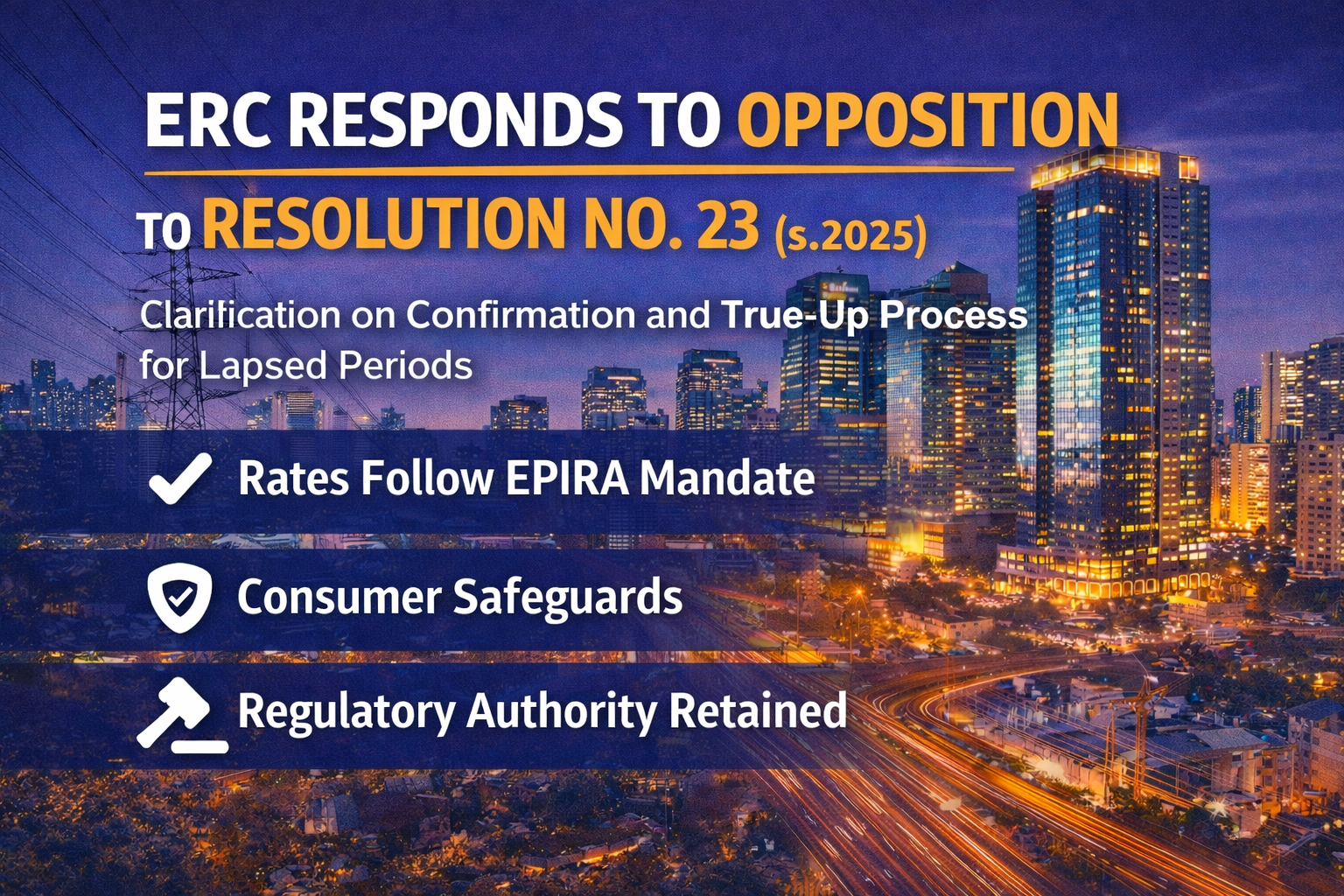
Clarification on Confirmation and True-Up Process for Lapsed Periods
On 18 February 2026, the Energy Regulatory Commission (ERC) issued a formal response addressing concerns raised regarding ERC Resolution No. 23, Series of 2025, particularly on the adoption of a confirmation and true-up process for Lapsed Periods of private distribution utilities (PDUs)
The Commission clarified its legal and regulatory position on the matter.
- There Is a Valid Rate for the True-Up
The ERC emphasized that the last approved Performance-Based Regulation (PBR) rates for each private distribution utility remain valid and enforceable until superseded by a new Commission decision or a court order
These approved rates—whether provisional or final—serve as the benchmark for determining over- or under-recovery during the Lapsed Period.
The confirmation step verifies previously authorized rates, while the true-up process corrects discrepancies between actual collections and allowable revenues on a prospective basis.
- The ERC’s Regulatory Authority
The Commission respectfully rejected the claim that the submission of AWAT applications by PDUs constitutes abdication of regulatory authority
Under the confirmation and true-up process:
- PDUs must submit their AWAT computations for ERC review and approval.
- The ERC retains full authority to evaluate, modify, or deny such submissions.
- The process does not delegate rate-setting power to utilities.
The Commission underscored that it remains the final arbiter of rates.
III. Compliance with EPIRA’s Least-Cost Mandate
The ERC explained that Resolution No. 23, s.2025 was issued to uphold the least-cost mandate under Section 43(f) of EPIRA
Key principles cited include:
- Rates must allow recovery of just and reasonable costs.
- Utilities are entitled to a reasonable return on rate base (RORB).
- Rate-setting methodologies must ensure a reasonable price of electricity.
- Rates must be non-discriminatory.
- Cross-subsidies must be eliminated.
- Efficiency must be promoted.
The Commission stated that the confirmation and true-up mechanism prevents regulatory vacuums and avoids retroactive ratemaking, which may raise legal concerns.
Consumer Protection Safeguards
According to the ERC, the confirmation and true-up process:
- Protects consumers from excessive rates;
- Ensures utilities recover only allowable revenues;
- Maintains regulatory continuity until each Entry Group begins its new First Regulatory Period.
The Commission noted that engaging in a purely ex-post recalculation covering a decade of lapsed periods could introduce substantial delays and legal risks.
- Proposed Course of Action
The ERC described the true-up mechanism as a transitional measure under Resolution No. 23, s.2025
This approach:
- Stabilizes the regulatory environment;
- Allows completion of regulatory results under the RRDWR framework;
- Preserves the Commission’s authority to conduct full rate reviews once new Regulatory Periods commence.
The ERC assured stakeholders that all concerns raised will form part of the official record and be considered in ongoing evaluations and implementation of the RRDWR.
Commitment to Fair and Transparent Rates
The Commission reiterated its commitment to ensuring that electricity rates remain fair and transparent
The letter concludes with an affirmation of continued stakeholder engagement as the ERC implements the RRDWR and addresses the Lapsed Periods.